
Saltwater · Year-round in deep water; most targeted spring through summer
Golden Tilefish
Lopholatilus chamaeleonticeps
The spotted jewel of the deep slope — golden tilefish live in mud burrow colonies hundreds of feet down along the Atlantic and Gulf shelf edge. Deep-drop rigs with squid over the right clay produce one of the finest food fish in the ocean.
Seasons · Peak
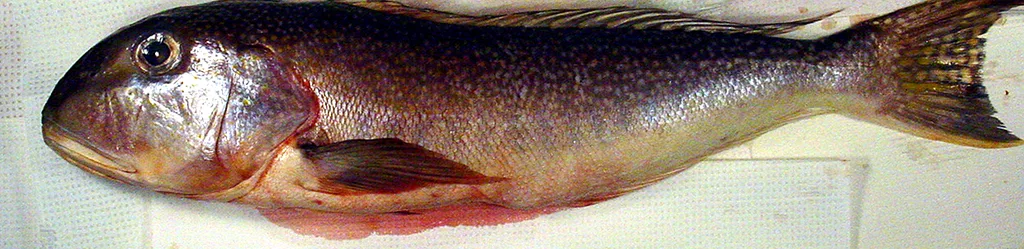
Identifying features
- Iridescent blue-green to silvery body covered in irregular golden-yellow spots
- A large, fleshy crest (ridge) on top of the head in front of the dorsal fin — the tilefish signature
- Bright yellow dorsal fin with spots, and a blunt, steep head with large eyes
- Soft, thick body built for life around mud burrows on the deep slope
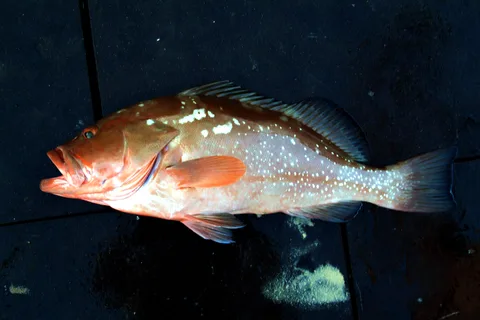
- Look-alike: red grouper are reddish-brown bottom fish of shallower reefs; tilefish carry the fleshy dorsal crest plus yellow spots and live in deep mud burrows
Habits
- Lives in burrows it digs in soft mud and clay on the continental slope in 250-1,500 ft
- Stays close to its burrow colony — whole fields of burrows (pueblos) mark good grounds
- Feeds on crabs, shrimp, squid and small fish picked off the bottom near the burrow
- Very temperature-sensitive — colonies hold where bottom water stays in a narrow, stable band
Distribution
Where to find them
- The mud slope off the Hudson and other mid-Atlantic canyons in 400-800 ft
- Deep slope grounds off the Carolinas and Georgia
- The tilefish grounds off southeast Florida and the eastern Gulf in 500-900 ft
- Soft-bottom edges along the Texas and Louisiana shelf break
Where they live
How to catch them
Deep-drop bait fishing
Rig: Electric reel, 3-5 lb weight, multi-hook deep-drop rig with lights
Bait/lure: Squid strips, bonito belly or whole squid
Key tip: Drift soft mud and clay near canyon edges and stay right on the bottom. Tilefish do not move far from their burrows — mark every bite.
Deep jigging the slope
Rig: Heavy jig of 12-20 oz worked in slow lifts just above the mud
Bait/lure: Glow and silver deep-water jigs tipped with squid
Key tip: Keep the jig in the lowest few feet and lift slowly. Tilefish hit softly for their size — wind into any extra weight.
Best baits & lures
Baseline setup
- Rod: 6-7 ft deep-drop rod, heavy, electric reel
- Line: 65 lb braid
- Terminal: Deep-drop rigs, circle hooks 6/0-8/0, 3-5 lb weights, drop lights
Recommended gear for this species
Rod · Best value
9' 5-weight fly rod outfit
≈ US$180-260
Covers chironomid lakes and small rivers with one setup.
Flies · Budget
Chironomid assortment (30 patterns)
≈ US$25-40
Chironomids are 60% of a lake rainbow's diet in spring.
Picks come from our rule library — never paid placements. Prices are guides; affiliate links may earn us a commission.
Typical size
Common 3-10 lb; large specimens 20-40 lb and up
On the table
Excellent — sweet, firm, lobster-like white flesh; one of the most prized deep-drop food fish on the east coast.
Similar species
Regulations vary by area and can change in-season — always check the official rules for your area before you fish. Regulations guide →
Plan a trip for Golden Tilefish
Build today's plan