
Saltwater · Summer and autumn over deep fjord structure
Atlantic Redfish
Sebastes norvegicus
The deep-water golden-red Sebastes of Norwegian fjords and the Barents Sea — a true redfish, often of astonishing age. It grows very slowly, so every fish deserves respect: keep only what you will eat, because fish hauled from the deep rarely survive release due to barotrauma. It is a true Sebastes, unlike Japan's smaller inshore Sebastiscus rockfish.
Seasons · Peak
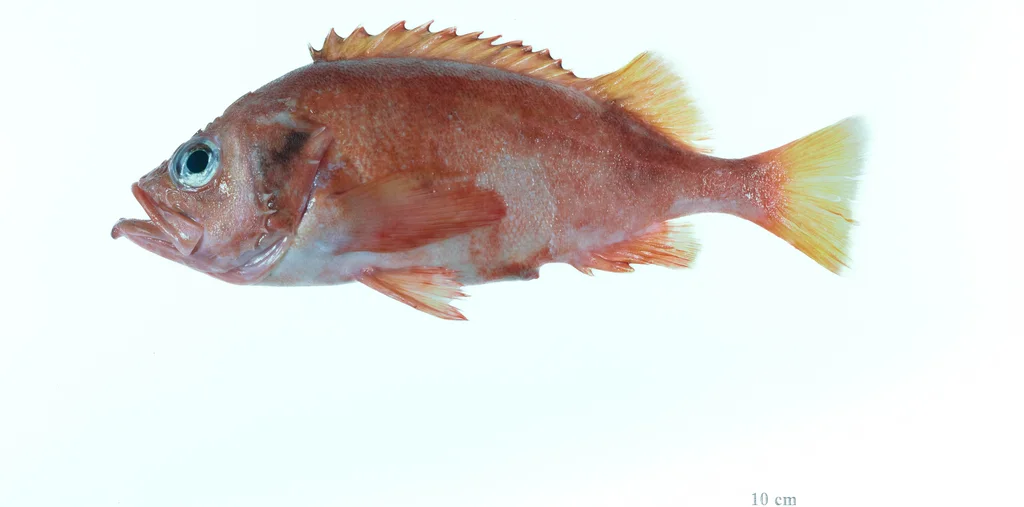
Identifying features
- Deep-bodied, vivid golden-red to orange-red all over
- Large dark eye and a spiny first dorsal fin
- Strong bony ridges and spines on the gill cover, including a pointed lower preopercular spine
- Large scales and a complete lateral line clearly visible
- Young are duller red-brown; big old fish turn a deep glowing red
Habits
- Very slow-growing and long-lived — many angled fish are decades old, so handle with care and keep only what you will eat
- Deep-caught fish suffer barotrauma: the swim bladder expands on the way up, eyes bulge and the stomach pushes out, and most cannot survive release
- Feeds on krill, small fish, squid and shrimp near the bottom and midwater
- Moves in loose aggregations over deep structure rather than true tight shoals
- Mates and gives birth to live young in late winter and spring
Distribution
Where to find them
- Deep slopes of northern Norwegian fjords
- Barents Sea banks out of Tromsø and Finnmark
- Deep drop-offs off the Lofoten Islands
Where they live
How to catch them
Baited deep-water paternoster Boat
Rig: Two-hook paternoster with 10/0 hooks and a 16-24 oz lead on a stiff boat outfit, lowered vertically to 200-500 m
Bait/lure: Mackerel chunks on each hook
Key tip: Wind up steadily and keep the fish if barotrauma shows — a pushed-out stomach means it cannot survive release.
Heavy pirk jigging on fjord slopes Boat
Rig: 14-21 oz pirk with a large hook, jigged over deep rocky drop-offs
Bait/lure: Bare or tipped with squid
Key tip: Work it in short lifts off the bottom and stay in contact — bites often come on the drop.
Best baits & lures
Baseline setup
- Rod: Stiff 6-7 ft deep-water boat rod
- Line: 30-50 lb braid
- Terminal: Heavy pirks and baited paternosters, 10/0 hooks
Recommended gear for this species
Rod · Best value
9' 5-weight fly rod outfit
≈ US$180-260
Covers chironomid lakes and small rivers with one setup.
Flies · Budget
Chironomid assortment (30 patterns)
≈ US$25-40
Chironomids are 60% of a lake rainbow's diet in spring.
Picks come from our rule library — never paid placements. Prices are guides; affiliate links may earn us a commission.
Typical size
Common 14-18 in (35-45 cm), about 2-4 lb (1-2 kg); large fish to 39 in (100 cm) and 33 lb (15 kg)
On the table
Good to excellent — firm white flakes, the classic Rotbarsch of German fish counters; deep fish are best kept, as most cannot be returned alive.
Similar species
Regulations vary by area and can change in-season — always check the official rules for your area before you fish. Regulations guide →
Plan a trip for Atlantic Redfish
Build today's plan