
Saltwater · Year-round on eastern Pacific reefs; most abundant around offshore islands
Blue-striped Snapper
Lutjanus viridis
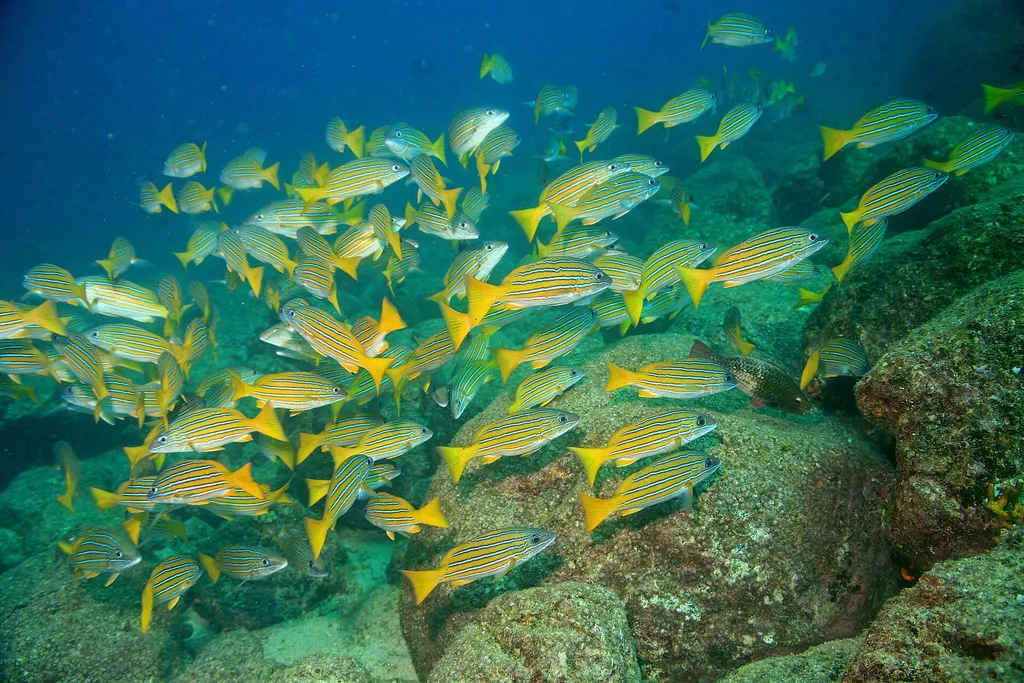
The smallest Pacific snapper, unmistakable in bright yellow with five blue-white stripes. It schools over rocky and coral reefs and matters mainly to local subsistence fisheries — and as a reef sight, not a sport target.
Seasons · Peak
Identifying features
- Brilliant yellow body and fins — the brightest Pacific snapper
- Five black-edged, bluish-white horizontal stripes along the sides
- Whitish belly crossed by narrow grey lines
- Small adult size — maximum only about 30 cm
- Strong preopercular notch and knob, typical of Lutjanus
Habits
- Lives in large schools over rocky and coral reefs, usually at 9-15 m within a 0-60 m range
- Particularly abundant at offshore islands — Revillagigedo, Cocos, Malpelo and Galápagos
- Discontinuous coastal distribution from southern Baja and the Gulf of California mouth to Peru
- A plankton-and-small-prey feeder taken mainly by local subsistence fisheries
Distribution
Where to find them
- Rocky reef tops at 9-15 m around offshore islands
- Inshore rocky reefs off mainland Mexico and Costa Rica
- Reef edges where yellow schools hover in the current
Where they live
How to catch them
Micro-bait reef fishing Boat
Rig: Ultralight spinning outfit, size 6-8 hook on a light dropper rig
Bait/lure: Tiny shrimp or squid pieces
Key tip: Fish directly over reef where the yellow schools hold at 9-15 m; baits must be tiny for this small-mouthed fish.
Light jigging from rocks Rock fishing
Rig: Light rod with a small metal jig or jig head
Bait/lure: Micro jig or small soft plastic
Key tip: Cast to reef edges off rocky points and retrieve slowly through the school; expect small fish and release most.
Best baits & lures
Baseline setup
- Rod: Ultralight-light 6'6" spinning rod
- Line: 6-10 lb braid or mono
- Terminal: Size 6-8 hooks, micro jigs, light leader
Recommended gear for this species
Rod · Best value
7'6" medium-heavy jigging rod
≈ US$110-170
Works 2-6 oz jigs over rock and reef and still has the backbone to lift a halibut off the bottom.
Line · Budget
50 lb braid with 40 lb leader (200 yd)
≈ US$25-40
Thin braid cuts the current so jigs stay vertical; the leader shrugs off rock and teeth.
Terminal · Budget
Leadhead jigs, swimbaits and two-hook bottom rigs
≈ US$25-40
A leadhead with a swimbait tail is the universal bottom-fish catcher, from rockfish to cod to flounder.
Picks are never paid placements. Prices are guides; price links are coming soon and none is an affiliate link yet.
Typical size
Common 20-25 cm; maximum 30 cm — the smallest member of the snapper family in the region
On the table
Eaten locally where caught, but very small; most visiting anglers release it and admire the school instead.
Similar species
Regulations vary by area and can change in-season — always check the official rules for your area before you fish. Regulations guide →
Plan a trip for Blue-striped Snapper
Build today's plan⚠ Heads-up: Blue-striped Snapper doesn't occur around Vancouver, BC (or is very rare there), so it's not a sensible local target. Your plan stays in Vancouver, BC and is built around the fish that actually live there.