
Saltwater · Year-round off Colombia, Ecuador and Peru; it does not reach Panama or any region in this guide.
Peruvian Rock Seabass
Paralabrax callaensis
A slow-growing rock seabass (perela in Ecuador) distributed only from Colombia to Peru, taken by artisanal bottom longlines; it does not reach Panama and is included for identification only.
Seasons · Peak
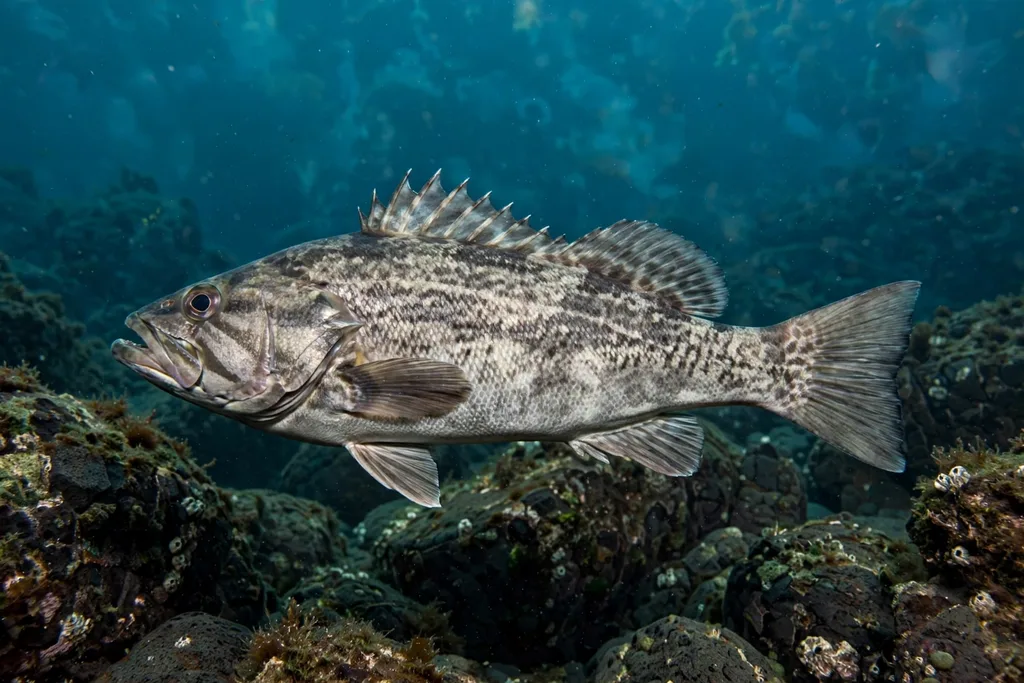
Identifying features
- Serranid bass profile: continuous dorsal fin, spiny first part
- Peruvian/Ecuadorian rocky-coast distribution separates it from Panamanian basses
- Mottled brown-grey camouflage over rock and sand
- Size at maturity about 34 cm — a relatively large, late-maturing bass
- Ecuadorian name 'perela' and Spanish 'mero sureño'
Habits
- Demersal over coastal rocky/sandy grounds, reported to about 50 m
- Slow growth (K about 0.21) and late maturity at about 3.2 years — vulnerable to overfishing
- Caught in Ecuador with bottom longlines using hooks No. 8-9 and clupeid/carapid baits
- Asymptotic length estimated about 68 cm in Ecuador study
Distribution
Regional coverage expanding
Where to find them
- Artisanal grounds off Manabi, Ecuador (outside our regions)
- Rocky coast of Peru incl. Callao, its type locality (outside our regions)
Where they live
How to catch them
Bottom fishing with natural bait Boat
Rig: Two-hook paternoster or Carolina rig with 1-3 oz sinker
Bait/lure: Live or fresh shrimp
Key tip: Keep the bait on the bottom over sand or mud and wait for the soft, tapping bite.
Spearfishing over rocky reefs Rock fishing
Rig: Freediving (breath-hold) with a short band speargun (75-90 cm), mask, snorkel and fins
Bait/lure: None - speargun; the fish is stalked and shot, not baited
Key tip: Work shallow rocky reefs and kelp edges slowly and take only mature fish you can clearly identify - this slow-growing bass matures at about 34 cm; check local spearfishing rules and protected areas before diving.
Best baits & lures
Baseline setup
- Rod: Medium spinning or conventional rod 7-9 ft
- Line: 20-30 lb braid with 30 lb fluorocarbon leader
- Terminal: 2/0-4/0 circle hooks, 2-4 oz sinker or jig
Recommended gear for this species
Rod · Best value
7'6" medium-heavy jigging rod
≈ US$110-170
Works 2-6 oz jigs over rock and reef and still has the backbone to lift a halibut off the bottom.
Line · Budget
50 lb braid with 40 lb leader (200 yd)
≈ US$25-40
Thin braid cuts the current so jigs stay vertical; the leader shrugs off rock and teeth.
Terminal · Budget
Leadhead jigs, swimbaits and two-hook bottom rigs
≈ US$25-40
A leadhead with a swimbait tail is the universal bottom-fish catcher, from rockfish to cod to flounder.
Picks are never paid placements. Prices are guides; price links are coming soon and none is an affiliate link yet.
Typical size
Estimated maximum about 68 cm (L-infinity, Ecuador study); commonly 32-34 cm.
On the table
Fine, firm flesh; a valued local food fish, good steamed, fried or in soups.
Similar species
Regulations vary by area and can change in-season — always check the official rules for your area before you fish. Regulations guide →
Plan a trip for Peruvian Rock Seabass
Build today's plan⚠ Heads-up: Peruvian Rock Seabass doesn't occur around Vancouver, BC (or is very rare there), so it's not a sensible local target. Your plan stays in Vancouver, BC and is built around the fish that actually live there.