
Freshwater · Breeding colours peak March to May; observable in clear riffles year-round
Rainbow Darter
Etheostoma caeruleum
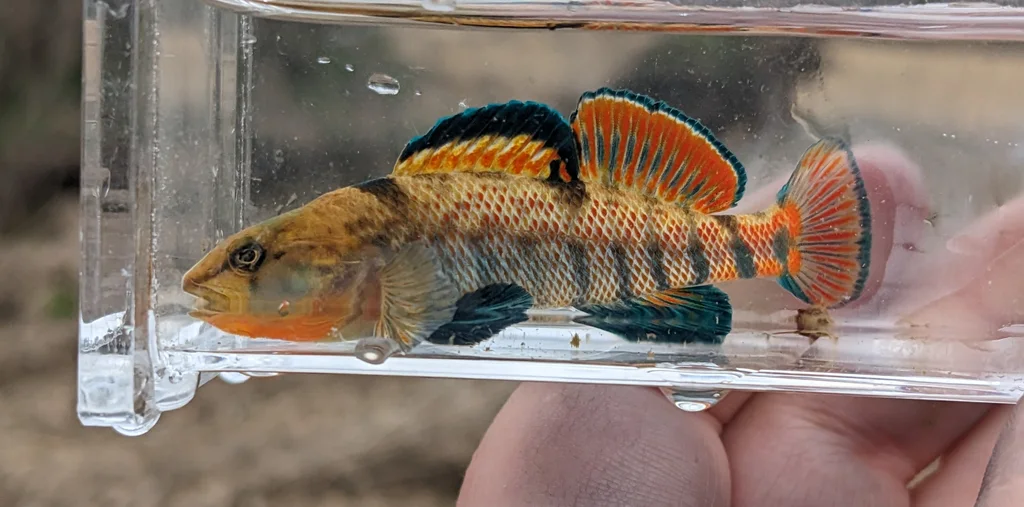
The rainbow darter is one of the most beautiful freshwater fish in the United States — breeding males turn electric blue and orange. It has no swim bladder and hops along the bottom of clean riffles instead of swimming in open water. Because it is sensitive to pollution, it is a classic clean-water indicator species.
Seasons · Peak
Identifying features
- Breeding males are electric blue and orange — blue-green bars, orange throat and belly
- Females and non-breeding males are mottled olive-brown with dark bars
- No swim bladder — it rests and hops on the bottom on its pectoral fins
- Small, slender perch-like body with two separate dorsal fins
- Downturned mouth suited to picking larvae from stones
Habits
- Lives on the bottom of fast, clear riffles over gravel and cobble
- Darts and hops between stones rather than swimming freely
- Feeds on mayfly, caddis and midge larvae picked from rocks
- Spawns in spring over clean gravel, males in full colour
- Disappears quickly from polluted or silted streams — a clean-water indicator
Distribution
Where to find them
- Gravel riffles in Great Lakes tributary creeks
- Clear rocky runs in Iowa-Missouri streams
- Clean Appalachian and Tennessee-Kentucky headwater riffles
Where they live
How to catch them
Tanago-style micro-fishing in riffles River
Rig: Ultralight or tanago rod, smallest hooks (size 20-24 or tanago hooks) with a worm bit, presented on the bottom at the edge of a riffle
Bait/lure: Tiny worm bits, midge larvae
Key tip: Work the quiet edge of a riffle, not the fastest water — darters hold behind stones.
Micro jigs in shallow rocky runs River
Rig: Ultralight rod with a 1/100-1/64 oz micro jig hopped slowly across shallow cobble
Bait/lure: Micro jigs
Key tip: Keep contact with the bottom and move the jig in short hops, the way a darter itself moves.
Best baits & lures
Baseline setup
- Rod: Ultralight 5-6 ft spinning or tanago rod
- Line: 1-3 lb mono or light tippet
- Terminal: Size 20-24 or tanago hooks, micro jigs, tiny split shot
Recommended gear for this species
Rod · Best value
9' 5-weight fly rod outfit
≈ US$180-260
Covers chironomid lakes and small rivers with one setup.
Flies · Budget
Chironomid assortment (30 patterns)
≈ US$25-40
Chironomids are 60% of a lake rainbow's diet in spring.
Picks come from our rule library — never paid placements. Prices are guides; affiliate links may earn us a commission.
Typical size
Common 2-3 in (5-8 cm); large fish to about 3 in (8 cm)
On the table
Not a food fish — tiny and best admired and released; also a clean-water indicator.
Regulations vary by area and can change in-season — always check the official rules for your area before you fish. Regulations guide →
Plan a trip for Rainbow Darter
Build today's plan