
Saltwater · Year-round on Caribbean reefs; mostly seen by divers and taken at dusk or at night rather than by daytime anglers.
Reef Croaker
Odontoscion dentex
A nocturnal reef croaker that shelters in caves and crevices on tropical western Atlantic reefs from Florida and Cuba to Brazil, emerging at night to feed on small fish and shrimp. Note: FishBase/Wikipedia report it absent from the Bahamas, so Bahamas is at most occasional.
Seasons · Peak
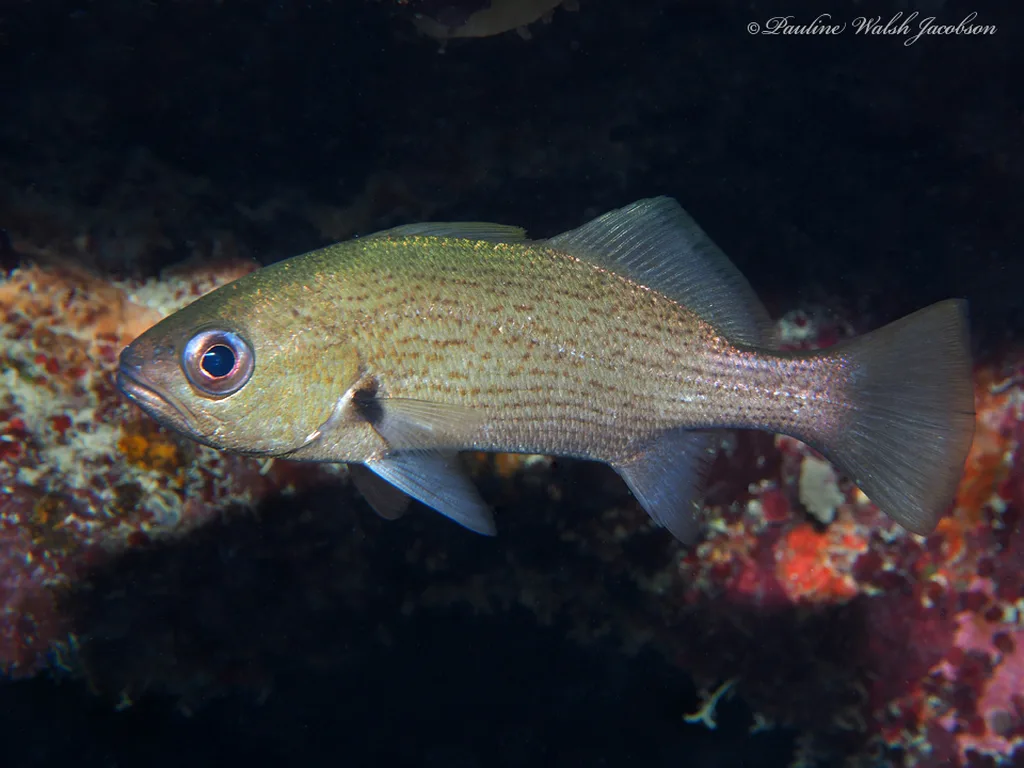
Identifying features
- Large eyes for a croaker — an adaptation to nocturnal feeding
- Brownish to silvery body, often with a darker back
- Lives on reefs, unlike the sand/mud-bottom Caribbean weakfishes
- Strong, prominent teeth (dentex) in a moderately large mouth
- Usually solitary or in small groups inside reef shelter by day
Habits
- Shelters in caves and crevices by day, feeds at night
- Feeds on small fish, shrimp and larvae
- Abundant in inshore reef water in much of the Caribbean
- Not targeted by large fisheries; taken as bycatch or in mixed small-scale catches
Distribution
Where to find them
- Reef caves and ledges off Puerto Rico and the Dominican Republic
- Inshore reefs of Caribbean Panama and Costa Rica
- Reef edges in Cuba and Florida (not a Bahamas regular)
Where they live
How to catch them
Night bottom fishing on deep reef Boat
Rig: Bottom rig or small jig fished vertically at night
Bait/lure: Squid strip or small shrimp
Key tip: Fish after dark over reef edges; bites are often subtle, so watch the rod tip closely.
Casting small lures Boat
Rig: Light spinning tackle with small jig or soft plastic
Bait/lure: Small shrimp or baitfish imitation
Key tip: Cast to reef edges and structure and retrieve slowly near the bottom.
Best baits & lures
Baseline setup
- Rod: Light to medium spinning rod 7-8 ft
- Line: 10-20 lb braid with 20 lb fluorocarbon leader
- Terminal: Size 1 to 2/0 circle or J hooks, 1-3 oz sinker
Recommended gear for this species
Rod · Best value
7'6" medium-heavy jigging rod
≈ US$110-170
Works 2-6 oz jigs over rock and reef and still has the backbone to lift a halibut off the bottom.
Line · Budget
50 lb braid with 40 lb leader (200 yd)
≈ US$25-40
Thin braid cuts the current so jigs stay vertical; the leader shrugs off rock and teeth.
Terminal · Budget
Leadhead jigs, swimbaits and two-hook bottom rigs
≈ US$25-40
A leadhead with a swimbait tail is the universal bottom-fish catcher, from rockfish to cod to flounder.
Picks are never paid placements. Prices are guides; price links are coming soon and none is an affiliate link yet.
Typical size
A small reef species, commonly 15-25 cm; maximum under about 30 cm.
On the table
Edible and eaten fresh or in soups; also used as bait when small.
Similar species
Regulations vary by area and can change in-season — always check the official rules for your area before you fish. Regulations guide →
Plan a trip for Reef Croaker
Build today's plan⚠ Heads-up: Reef Croaker doesn't occur around Vancouver, BC (or is very rare there), so it's not a sensible local target. Your plan stays in Vancouver, BC and is built around the fish that actually live there.