
Saltwater · Year-round on offshore reefs; best from late spring through fall
Scamp
Mycteroperca phenax
A prized Gulf and South Atlantic grouper of deep natural reefs, recognised by its yellow mouth corners and cat-paw blotches. In Florida it is nicknamed 'broomtail' for its ragged, broom-like tail — but the true Broomtail Grouper is a different Pacific species, Mycteroperca xenarcha, so the nickname belongs to this fish only as local slang.
Seasons · Peak
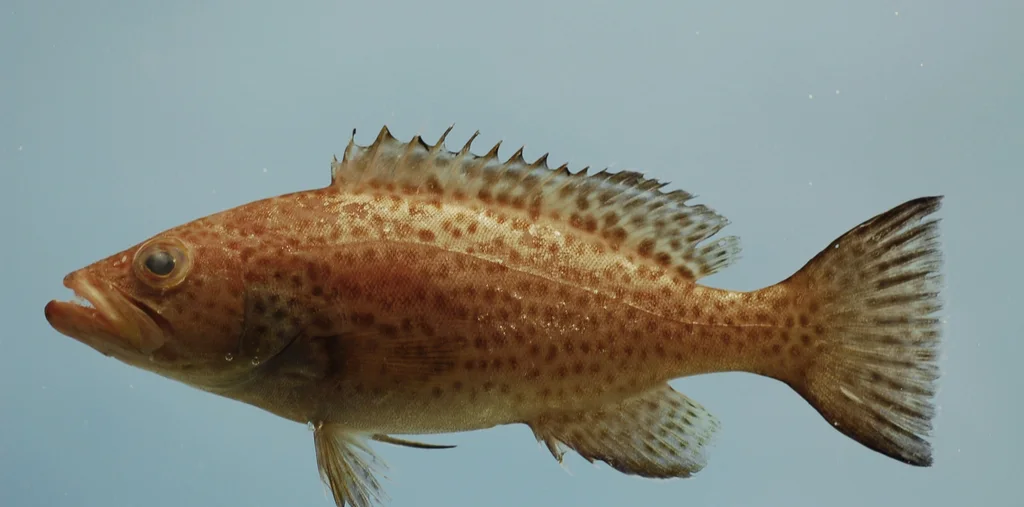
Identifying features
- Yellow wash and yellow-brown corners at the mouth — the quickest field mark
- Dark brown blotches clustered like cat-paw prints over a tan to light-brown body
- Ragged, concave tail with longer upper and lower rays, giving the 'broomtail' look
- Pointed head with a slightly concave snout profile
- Fins marked with dark spots and pale edges, especially in younger fish
Habits
- Holds tight to reef, ledges and hard bottom, rarely roaming far from structure
- Feeds on small reef fish, squid, octopus and shrimp picked off the bottom
- Usually solitary or in small groups; larger fish dominate the best ledges
- Females change sex to male with age, as in other groupers
- Spawns in spring, roughly February to June, at reef-edge aggregation sites
Distribution
Where to find them
- Natural reefs and ledges off the Florida Panhandle in the northern Gulf
- Offshore hard bottom and rig-adjacent ledges off Louisiana
- South Atlantic reef ledges off the Carolinas and Florida's Atlantic coast
Where they live
How to catch them
Bottom fishing live bait over natural reef Boat
Rig: Boat rod with a knocker or fish-finder rig, 6/0-8/0 circle hook and 6-12 oz sinker, fished on natural reef and ledges in 100-300 ft (30-90 m)
Bait/lure: Live pinfish, pigfish or sardines
Key tip: Anchor or drift precisely over the ledge edge — scamp hold tight to structure and rarely chase a bait far.
Slow-pitch jigging over hard bottom Boat
Rig: Slow-pitch jigging rod with 100-200 g jigs worked just above hard bottom and low reef
Bait/lure: Slow-pitch metal jigs, plain or tipped with a squid strip
Key tip: Keep the jig near the bottom with slow lifts; most strikes come on the fall close to the reef.
Best baits & lures
Baseline setup
- Rod: Medium-heavy 6.5-7.5 ft boat rod
- Line: 50-65 lb braid with 60-80 lb fluorocarbon leader
- Terminal: 6/0-8/0 circle hooks, 6-12 oz sinkers, heavy swivels
Recommended gear for this species
Rod · Best value
9' 5-weight fly rod outfit
≈ US$180-260
Covers chironomid lakes and small rivers with one setup.
Flies · Budget
Chironomid assortment (30 patterns)
≈ US$25-40
Chironomids are 60% of a lake rainbow's diet in spring.
Picks come from our rule library — never paid placements. Prices are guides; affiliate links may earn us a commission.
Typical size
Common 14-24 in (36-61 cm), 2-6 lb (0.9-2.7 kg); large fish to about 42 in (107 cm) and over 30 lb (13.6 kg)
On the table
Excellent — widely rated among the finest-tasting groupers, with firm white flakes.
Similar species
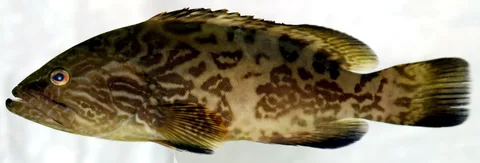 Gag GrouperGag is plain grey to brown with worm-like mottling and no yellow mouth corners; scamp shows yellow at the mouth, cat-paw blotches and a ragged broom-like tail
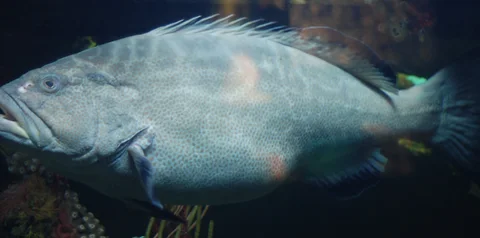 Black GrouperBlack grouper has neat rectangular block blotches and a squared-off tail; scamp is smaller with cat-paw clusters, yellow mouth corners and a concave ragged tail
Regulations vary by area and can change in-season — always check the official rules for your area before you fish. Regulations guide →
Plan a trip for Scamp
Build today's plan