
Freshwater · Spring best during upstream runs; seasons are limited and vary by state — check current rules before fishing
Shovelnose Sturgeon
Scaphirhynchus platorynchus
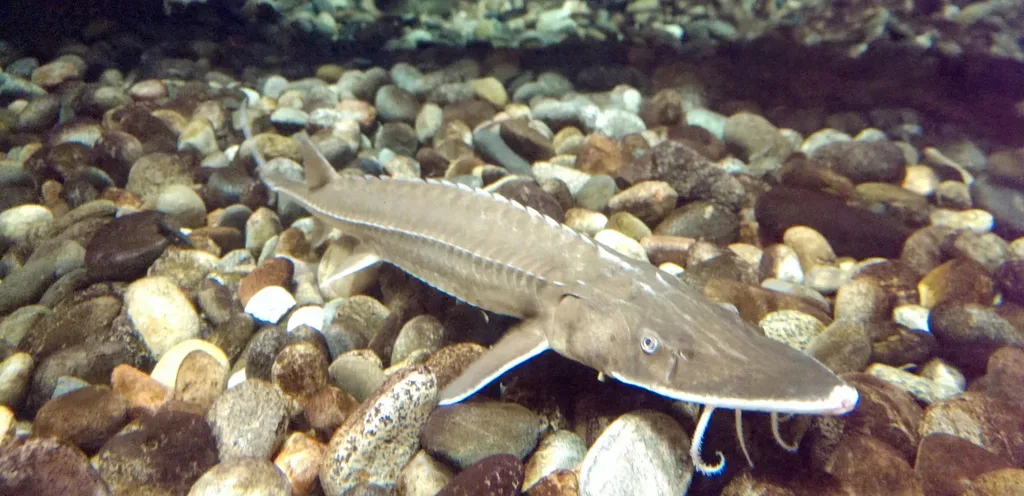
A small river sturgeon with a flattened, shovel-shaped snout, native to the Missouri and Mississippi systems. Critical caution: the nearly identical pallid sturgeon is endangered under the ESA and must be released immediately — learn the split before fishing (shovelnose has a belly fully covered in scale-like plates and its four barbels set in a straight row; pallid sturgeon has a mostly bare, smooth belly and staggered barbel bases). Legal seasons for shovelnose are limited and vary by water, so always check current regulations.
Seasons · Peak
Identifying features
- Broad, flattened shovel-shaped snout with four fringed barbels underneath
- Belly fully covered with scale-like plates — a key split from the endangered pallid sturgeon
- Four barbel bases set in a straight line; on pallid sturgeon the bases are staggered and the belly is mostly bare
- Rows of bony plates along the back and sides instead of normal scales
- Shark-like, upturned tail with the upper lobe much longer than the lower
Habits
- Holds in current over sand and gravel, sweeping the bottom for food
- Feeds on insect larvae, small crustaceans and other bottom invertebrates
- Migrates upstream in spring to spawn over gravel in flowing water
- Any pallid sturgeon — bare belly, staggered barbel bases — must be released unharmed at once
- Long-lived and slow to mature, so stocks recover slowly and seasons stay limited
Distribution
Where to find them
- Sandy channels of the Missouri River in Iowa, Nebraska and the Dakotas
- Mississippi River tailwaters below dams in spring
- Deep main-channel runs of the lower Missouri and upper Mississippi
Where they live
How to catch them
Bottom fishing sandy channels River
Rig: Medium-heavy rod, slip-sinker rig heavy enough to hold in current, size 2-4 hook fished on sand flats in the Missouri and Mississippi (only where seasons are open)
Bait/lure: Nightcrawlers, cut bait
Key tip: Anchor above a sand flat and fish straight down-current; check every sturgeon against the pallid split before it leaves the water.
Spring tailwater bottom fishing River
Rig: Bottom rig with a bank sinker and worm bait, cast into the slower seams below dams during the spring run
Bait/lure: Worm clusters
Key tip: Spring fish gather below dams — fish the current seams, and release anything you cannot positively identify as a shovelnose.
Best baits & lures
Baseline setup
- Rod: Medium-heavy 7-8 ft river rod
- Line: 15-25 lb mono or braid
- Terminal: Slip sinkers 2-4 oz, size 2-4 hooks, sturdy swivels
Recommended gear for this species
Rod · Best value
8' extra-heavy boat rod
≈ US$130-200
Sturgeon and paddlefish are the biggest fish in fresh water — this is big-game tackle, not a bass rod.
Reel & line · Best value
Conventional reel with 65-80 lb braid
≈ US$150-230
Hundreds of yards of heavy braid and a smooth, strong drag for fish that can pass 100 lb.
Terminal · Budget
Sliding sinker rigs and large barbless circle hooks
≈ US$20-30
Heavy weights hold bait on the bottom in river current where sturgeon feed; barbless hooks release cleanly.
Picks come from our rule library — never paid placements. Prices are guides; affiliate links may earn us a commission.
Typical size
Common 20-30 in and 1-3 lb (51-76 cm, 0.5-1.4 kg); large fish to about 32 in and 5 lb (81 cm, 2.3 kg)
On the table
Good smoked or fried where keeping is legal — but seasons and size limits are strict and vary; when in doubt, release.
Similar species
Regulations vary by area and can change in-season — always check the official rules for your area before you fish. Regulations guide →
Plan a trip for Shovelnose Sturgeon
Build today's plan