
Saltwater · Year-round on Pacific reefs; Galápagos records peak in the warm season
Stone Triggerfish
Pseudobalistes naufragium
The world's largest triggerfish — a metre-long, plate-scaled Pacific giant that blows into sand to uncover urchins and crustaceans, and a rare, powerful catch for bottom anglers on the Baja and mainland Pacific coasts.
Seasons · Peak
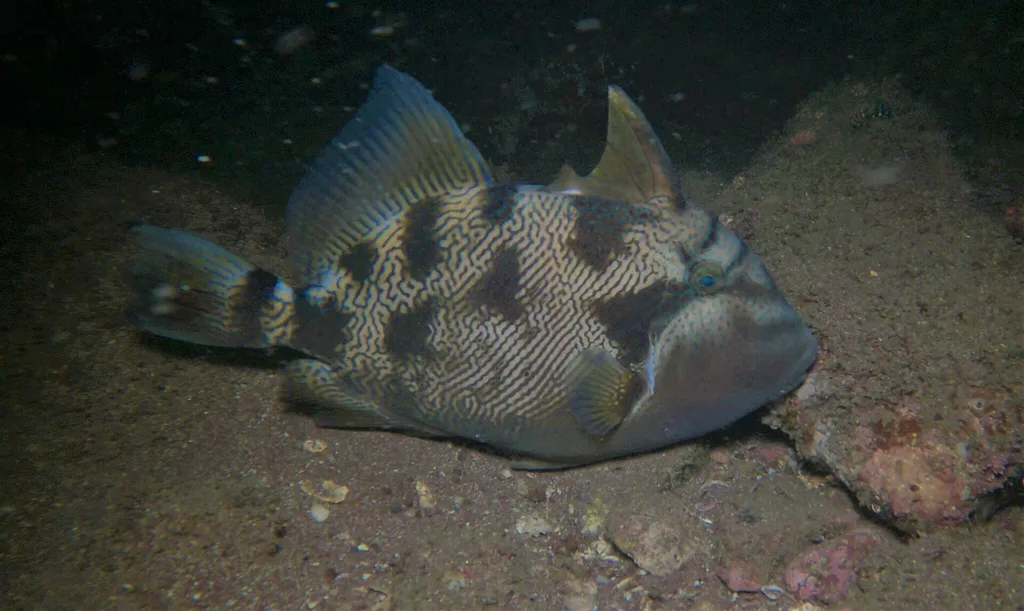
Identifying features
- The largest triggerfish in the world — to 100 cm TL
- Huge, thick plate-like scales covering the body
- A scaleless groove-like area behind the jaws
- Only 8 strong, protruding teeth in each jaw
- Dull gray-brown colour with enlarged scales behind the gill opening forming a tough shoulder shield
Habits
- Blows into sand and pries with its jaws to uncover burrowing prey
- Feeds mainly on sea urchins, small crustaceans and molluscs
- Adults hold over sand near reefs, often deeper than 15 m
- Solitary or in small groups; cautious despite its size
Distribution
Where to find them
- Sand channels beside Baja rocky reefs
- Reef edges at 15-35 m off mainland Mexico and Costa Rica
- Urchin grounds on sand near reef structure
Where they live
How to catch them
Heavy triggerfish bottom rig Boat
Rig: Medium-heavy spinning or conventional tackle, 40-50 lb braid, chicken rig with strong No. 2/0-3/0 hooks and small tough bait pieces
Bait/lure: Crab, clam or squid pieces
Key tip: Use triggerfish-small baits but heavyweight hooks and leader: a stone triggerfish bites like a triggerfish and pulls like a grouper, and its teeth shear light mono.
Reef-edge bait fishing Boat
Rig: Conventional outfit, knocker rig with 3/0 circle hook, 50-60 lb fluorocarbon leader
Bait/lure: Squid or clam chunk
Key tip: Anchor up-current of sand channels beside reefs and keep baits on the sand; expect slow, nibbling bites before the solid take.
Best baits & lures
Baseline setup
- Rod: 7 ft medium-heavy boat rod
- Line: 40-50 lb braid with 50-60 lb fluorocarbon leader
- Terminal: Strong 2/0-3/0 hooks, chicken rigs, 2-4 oz sinkers
Recommended gear for this species
Rod · Best value
7'6" medium-heavy jigging rod
≈ US$110-170
Works 2-6 oz jigs over rock and reef and still has the backbone to lift a halibut off the bottom.
Line · Budget
50 lb braid with 40 lb leader (200 yd)
≈ US$25-40
Thin braid cuts the current so jigs stay vertical; the leader shrugs off rock and teeth.
Terminal · Budget
Leadhead jigs, swimbaits and two-hook bottom rigs
≈ US$25-40
A leadhead with a swimbait tail is the universal bottom-fish catcher, from rockfish to cod to flounder.
Picks are never paid placements. Prices are guides; price links are coming soon and none is an affiliate link yet.
Typical size
Common about 50 cm; maximum 100 cm TL — the largest triggerfish known
On the table
Eaten locally in parts of the eastern Pacific; thick skin and plate scales make it hard to clean — check local rules.
Similar species
Regulations vary by area and can change in-season — always check the official rules for your area before you fish. Regulations guide →
Plan a trip for Stone Triggerfish
Build today's plan⚠ Heads-up: Stone Triggerfish doesn't occur around Vancouver, BC (or is very rare there), so it's not a sensible local target. Your plan stays in Vancouver, BC and is built around the fish that actually live there.