
Freshwater · Year-round in Florida spring rivers; best February to May when males colour up
Suwannee Bass
Micropterus notius
The smallest black bass, a jewel of Florida's clear limestone spring rivers — the Suwannee and Santa Fe rivers are the heart of its range. Breeding males glow with bright turquoise on the cheeks and belly. It rarely grows large, but on light tackle in gin-clear water it is a prized, place-bound catch.
Seasons · Peak
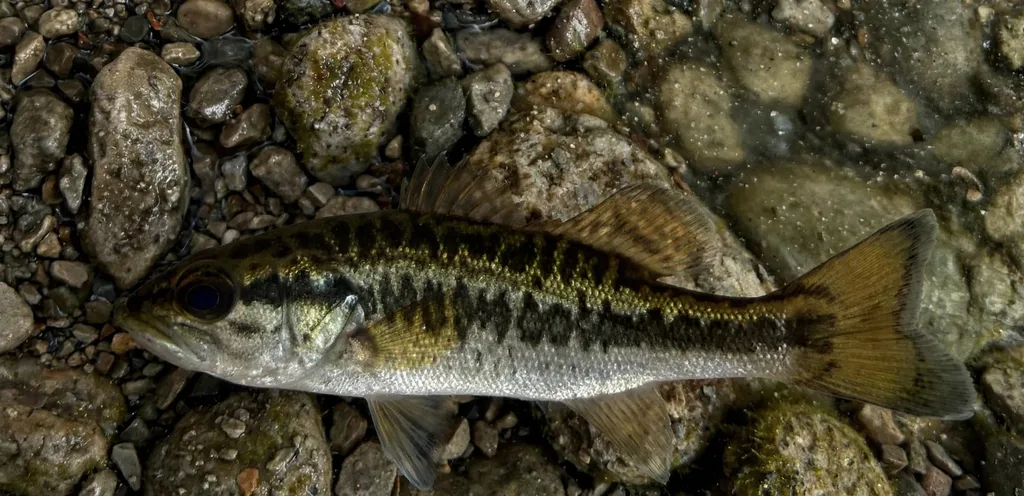
Identifying features
- Bright turquoise on the cheeks and belly of breeding males
- Smallest of the black basses — adults rarely pass 12-16 in
- Dark blotch at the base of the tail and a dark lateral pattern
- Large mouth like a largemouth, but on a much smaller, slimmer frame
- Scales on the base of the soft dorsal fin; brown-olive back
Habits
- Holds tight to limestone rock, snags and undercut banks
- Feeds on crayfish, shrimp, insects and small fish
- Spawns from late winter into spring on limestone and gravel
- Lives its whole life in a handful of spring-fed Florida and south Georgia rivers
- Wary in clear water — long, quiet casts catch more fish
Distribution
Where to find them
- Suwannee River, Florida — the heart of its range
- Santa Fe River spring runs in north Florida
- Withlacoochee and Ochlockonee rivers in Florida and Georgia
Where they live
How to catch them
Light spinning lures along limestone banks Shore
Rig: Light spinning outfit, small crankbait or soft plastic cast tight to limestone banks and spring runs and retrieved with the current
Bait/lure: Small crankbaits and soft plastics
Key tip: In clear spring water, stay low, cast long and use light line — Suwannees spook easily.
Small lures and flies tight to snags Shore
Rig: Light spinning rod or 4-5 weight fly rod, inline spinner, small crankbait or fly worked tight to snags and undercut banks
Bait/lure: Spinners, small crankbaits and flies
Key tip: Put the lure right against cover — this bass rarely leaves its rock or snag to chase.
Best baits & lures
Baseline setup
- Rod: Light 6-6.5 ft spinning rod, or 4-5 weight fly rod
- Line: 4-8 lb mono or fluorocarbon
- Terminal: Small crankbaits, inline spinners, 1/16-1/8 oz jigs and small flies
Recommended gear for this species
Rod · Best value
7'3" medium-heavy casting rod
≈ US$100-150
One rod for jigs, Texas rigs and frogs — the bass workhorse.
Reel · Budget
7.1:1 baitcasting reel
≈ US$80-120
Fast retrieve for pitching and quickly taking up slack on hooksets.
Line · Budget
15 lb fluorocarbon (200 yd)
≈ US$18-25
Invisible in clear water, sensitive on rock, abrasion resistant.
Picks come from our rule library — never paid placements. Prices are guides; affiliate links may earn us a commission.
Typical size
Common 8-14 in, 0.5-1.5 lb (0.2-0.7 kg); large fish under 4 lb (1.8 kg)
On the table
Fair, but its small size and limited range mean most anglers release it.
Similar species
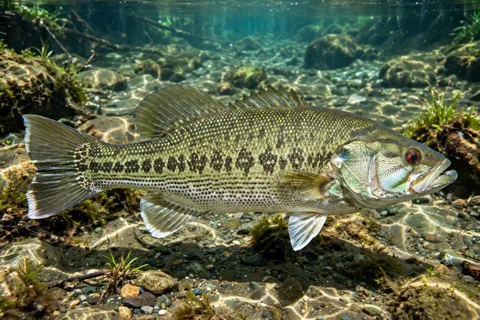 Shoal BassShoal bass is larger, lives in rocky shoals of the Flint and Chattahoochee, and never shows turquoise; Suwannee bass is the small spring-river fish with turquoise cheeks and belly
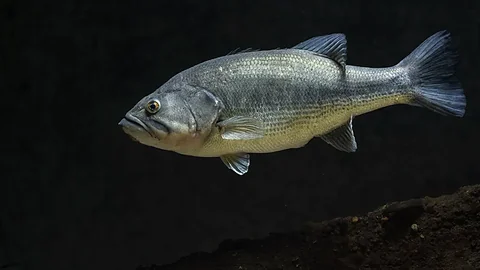 Largemouth BassLargemouth bass grows far larger in lakes and ponds and is plain green with no turquoise; Suwannee bass stays small in clear spring rivers
Regulations vary by area and can change in-season — always check the official rules for your area before you fish. Regulations guide →
Plan a trip for Suwannee Bass
Build today's plan