
Saltwater · Year-round; best in estuaries in the dry season and along surf beaches when shrimp and sardines move in
White Corvina
Cynoscion albus
The largest Pacific corvina of Central America — a silvery croaker of estuary mouths and surf from southern Mexico to Panama, prized on the table and taken on shrimp, sardines and soft plastics around river mouths in Costa Rica and Panama.
Seasons · Peak
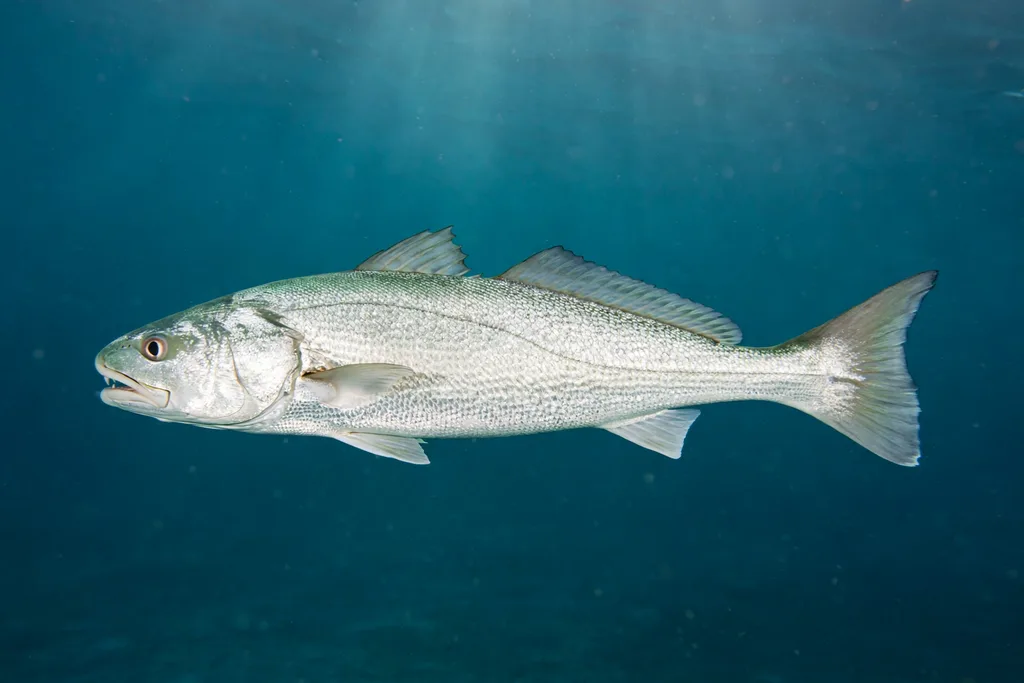
Identifying features
- Silvery-white body with a greenish back and no dark spots or bars
- Soft dorsal fin long-based; anal fin short with a weak spine
- Two small canine teeth at the tip of the upper jaw and no chin barbel
- Fins pale to yellowish; tail slightly double-concave
- Look-alike: other Pacific corvinas are smaller or yellow-finned; this is the big, plain white species reaching over a metre
Habits
- Adults hold over sand and mud in coastal water; juveniles enter estuaries and shallow bays
- Feeds on shrimp, small fishes and squid, often at dawn, dusk and on moving tides
- Croaks audibly when spawning aggregations form near river mouths
- Moves up estuary channels with the flood tide and drops back to holes on the ebb
Distribution
Where to find them
- Deep holes and channel bends inside estuary mouths
- Surf troughs beside river-mouth sandbars
- Mangrove channel edges on the first of the flood tide
- Sandy points where lagoon water drains to the sea
Where they live
How to catch them
Estuary bottom fishing with shrimp Boat
Rig: Medium spinning rod, fish-finder rig with 1-3 oz sinker and 3/0 circle hook
Bait/lure: Live or fresh shrimp; cut sardine as backup
Key tip: Anchor on the up-current edge of a channel hole and fish the tide change, when corvina feed hardest.
Soft plastics along channel edges Boat
Rig: 1/2-3/4 oz jig head with a 4-5 in shad tail on 20-30 lb braid
Bait/lure: Paddle-tail soft plastics in white or chartreuse
Key tip: Bounce the jig down the channel slope on the ebb; strikes come as it lifts off the bottom.
Surf casting at river mouths Shore
Rig: 9-10 ft surf rod, Carolina rig with shrimp or sand crab
Bait/lure: Fresh shrimp, sand crabs
Key tip: Work the trough beside the river-mouth bar at dawn on a rising tide.
Best baits & lures
Baseline setup
- Rod: 7 ft medium spinning rod; 9-10 ft surf rod from the beach
- Line: 20-30 lb braid, 30 lb fluorocarbon leader
- Terminal: Jig heads, fish-finder rigs, 3/0 circle hooks
Recommended gear for this species
Rod · Best value
9' medium-heavy surf spinning rod
≈ US$110-170
Casts plugs and bait past the breakers and handles stripers, drum and bluefish in the wash.
Reel · Best value
5000 size sealed spinning reel
≈ US$120-180
Salt spray and dunkings kill cheap reels — a sealed body and 30 lb braid capacity are the surf standard.
Terminal · Budget
Topwater plugs, soft-plastic jigs and fish-finder rigs
≈ US$25-40
Plugs for blitzes, jigs for the trough, bait on a fish-finder rig when they won't chase — the inshore trio.
Picks are never paid placements. Prices are guides; price links are coming soon and none is an affiliate link yet.
Typical size
Common 3-10 lb; large specimens 20 lb and up (max about 130 cm TL)
On the table
Excellent — firm white flesh, one of the best-eating inshore fish on the Pacific coast of Central America.
Similar species
Regulations vary by area and can change in-season — always check the official rules for your area before you fish. Regulations guide →
Plan a trip for White Corvina
Build today's plan⚠ Heads-up: White Corvina doesn't occur around Vancouver, BC (or is very rare there), so it's not a sensible local target. Your plan stays in Vancouver, BC and is built around the fish that actually live there.