
Saltwater · Year-round in Baja and the Sea of Cortez; warm-water years bring stragglers to Southern California
Broomtail Grouper
Mycteroperca xenarcha
The broomtail grouper is a large Pacific Mycteroperca named for the ragged, broom-like margin of its tail fin, with juveniles in mangroves and adults on rocky reefs and wrecks from Baja to Panama. Catches have declined, so big fish matter for the spawning stock.
Seasons · Peak
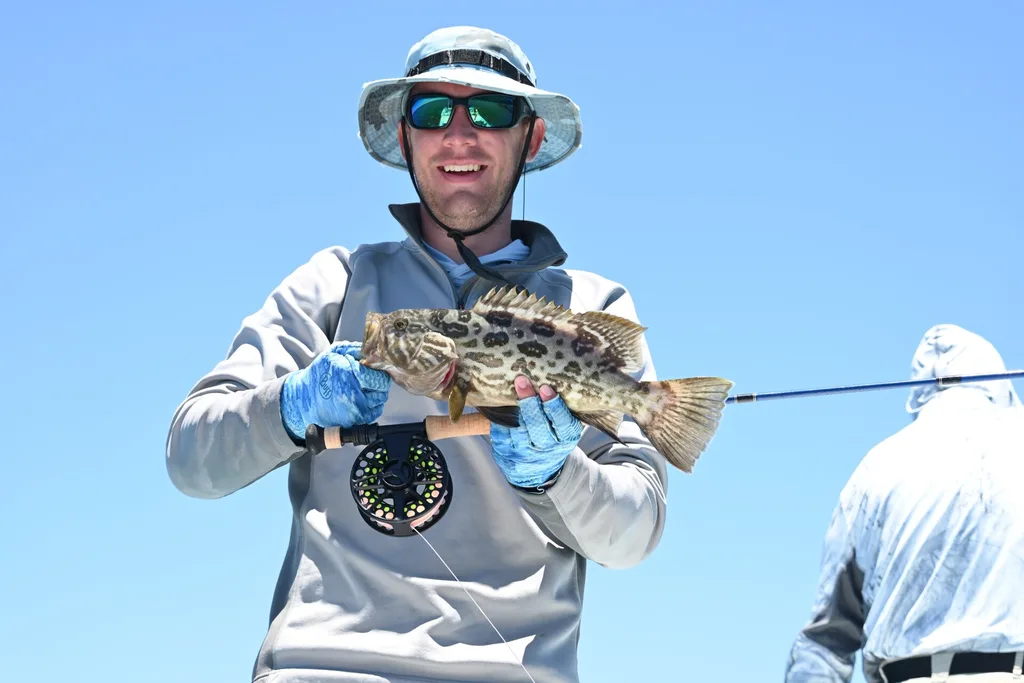
Identifying features
- Tail (caudal fin) margin is uneven and ragged — the spines and rays project like a broom, giving the name
- Two colour phases: brown phase with a pale maze-like reticulated pattern, and a plain grey-brown phase
- Body robust and elongate with a slightly concave head profile
- Serrations on the preopercle (gill cover edge) become coarse, almost spiny, in large adults
- Often confused with other Mycteroperca — the ragged 'broom' tail edge is the decisive mark
Habits
- Juveniles grow up in mangrove estuaries, then move offshore to hard shelf bottom as adults
- Ambush predator of fish, squid and crustaceans around rocks and wrecks
- Two colour patterns — brown-blotched and plain grey-brown — appear in the same areas
- Adults are solitary and site-attached; big fish hold the same pinnacle for long periods
Distribution
Where to find them
- Baja Pacific: rocky points and Magdalena Bay (juveniles in the mangroves)
- Sea of Cortez: islands and pinnacles from Bahía de los Ángeles to La Paz
- Mexico mainland Pacific: reefs off Mazatlán and Puerto Vallarta (common)
- Costa Rica and Panama Pacific: reefs and wrecks (common)
Where they live
How to catch them
Live bait on the bottom at reefs and wrecks Boat
Rig: Heavy conventional rig, 7/0-9/0 circle hook, bait pinned near the bottom over hard bottom
Bait/lure: Live sardines, mackerel and caballito (bigeye scad)
Key tip: Anchor or drift over pinnacles and wrecks in the Cortez and off Baja — the standard panga-guide method for big cabrillas.
Swimbaits and slow-pitch jigging Boat
Rig: Jigging rod, 50-80 lb braid, lures dropped tight to structure
Bait/lure: Large soft swimbaits and slow-pitch jigs
Key tip: Work the lure against structure — groupers hit on the fall or first lift; corroborated by Cortez charter sources.
Whole squid and octopus on the bottom Boat
Rig: Heavy bottom rig with whole squid on circle hooks
Bait/lure: Whole squid and octopus on heavy bottom rigs
Key tip: The traditional mainland method for big groupers on deep reefs — patience on known wrecks and pinnacles.
Best baits & lures
Baseline setup
- Rod: Heavy conventional or jigging rod 6.5-7 ft
- Line: 50-80 lb braid with 60-80 lb fluorocarbon leader (rock abrasion)
- Terminal: 8-12 oz sinkers, strong 7/0-9/0 circle hooks, heavy slow-pitch jigs and swimbaits
Recommended gear for this species
Rod · Best value
7'6" medium-heavy jigging rod
≈ US$110-170
Works 2-6 oz jigs over rock and reef and still has the backbone to lift a halibut off the bottom.
Line · Budget
50 lb braid with 40 lb leader (200 yd)
≈ US$25-40
Thin braid cuts the current so jigs stay vertical; the leader shrugs off rock and teeth.
Terminal · Budget
Leadhead jigs, swimbaits and two-hook bottom rigs
≈ US$25-40
A leadhead with a swimbait tail is the universal bottom-fish catcher, from rockfish to cod to flounder.
Picks are never paid placements. Prices are guides; price links are coming soon and none is an affiliate link yet.
Typical size
To about 1 m; historically to 45 kg, today most adults are 5-15 kg
On the table
Excellent — prime white-fleshed grouper highly prized in Baja as 'cabrilla plomuda'. Because stocks have thinned, many anglers keep only modest fish and release the biggest spawners.
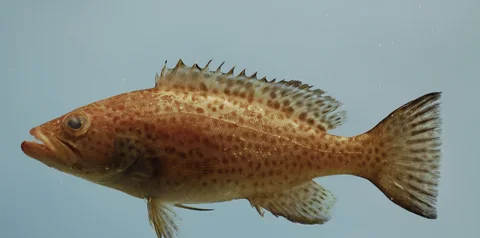
Similar species
Regulations vary by area and can change in-season — always check the official rules for your area before you fish. Regulations guide →
Plan a trip for Broomtail Grouper
Build today's plan⚠ Heads-up: Broomtail Grouper doesn't occur around Vancouver, BC (or is very rare there), so it's not a sensible local target. Your plan stays in Vancouver, BC and is built around the fish that actually live there.