
Freshwater · Late spring and summer in weedy ponds
Crucian Carp
Carassius carassius
This is the TRUE European crucian carp, Carassius carassius — not to be confused with the guide's older crucian-carp page, which covers Carassius auratus, the East Asian fish whose wild form is the goldfish; the two pages cross-reference each other. Once the classic village-pond fish, the European crucian is now declining across Europe, threatened further by hybridisation with goldfish and gibel carp.
Seasons · Peak
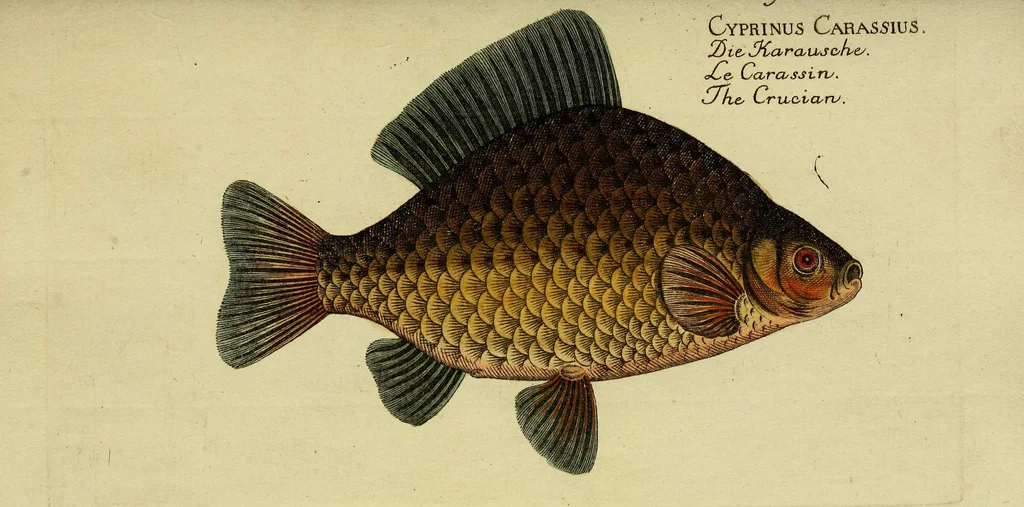
Identifying features
- Very deep, laterally compressed body with a strongly convex (humped) dorsal fin edge
- NO barbels at the mouth — the key split from common carp
- A dark spot at the base of the tail, strongest in young fish
- Reddish-brown fins and large golden-bronze scales, back olive to bronze
- Small upturned mouth; lateral line complete, unlike the broken line of gibel carp hybrids
Habits
- A true pond specialist that thrives in small, weedy, oxygen-poor water where few fish survive
- Declining across Europe as ponds are lost and goldfish and gibel carp spread
- Readily hybridises with goldfish and gibel carp, which threatens genetically pure populations
- Feeds on insect larvae, snails and plant matter, mostly at dawn and dusk
- Can survive under ice and in near-drying ponds by slowing its metabolism to a standstill
Distribution
Where to find them
- Weedy village and estate ponds in England and northern Germany
- Lily-covered drains and polder waters in the Netherlands
- Old fen and peat pools in central Europe
Where they live
How to catch them
Fine float fishing at the lily edge Lake
Rig: Light float rod or pole with a sensitive float over a cleared hole in the weed, bait fished just on the bottom
Bait/lure: Bread paste, maggots, small worms
Key tip: Keep quiet on the pond and fish dawn or dusk — big crucians are wary fish in small waters.
Short-pole fishing in weed openings Lake
Rig: Short pole fished over lily openings and weed edges with light shotting and a size 18 hook, bait presented on a slow fall
Bait/lure: Sweetcorn, bread flake, pinkies
Key tip: Releasing fish helps pure populations — photograph hybrids for ID and never move suspect fish to other ponds.
Best baits & lures
Baseline setup
- Rod: Light 11-12 ft float rod or whip
- Line: 3-5 lb mono with a fine hooklength
- Terminal: Sensitive pole floats, size 16-20 hooks, light shotting
Recommended gear for this species
Rod · Best value
8' medium-heavy catfish rod
≈ US$80-130
Long enough to lob heavy bait rigs, strong enough to move a flathead off the bottom.
Reel · Budget
Baitcasting or 4000-6000 spinning reel
≈ US$60-100
Line capacity and drag for long runs — catfish and carp both make them.
Terminal · Budget
Circle hooks, sliding sinkers and cut-bait rigs
≈ US$15-25
A slip-sinker rig with a circle hook is the proven bottom setup for cats and carp alike.
Picks come from our rule library — never paid placements. Prices are guides; affiliate links may earn us a commission.
Typical size
Common 6-10 in (15-25 cm), about 0.5-1 lb (0.2-0.5 kg); pond giants to 20 in (50 cm) and about 6 lb (2.7 kg) are rare
On the table
Fair — soft, earthy and bony; traditionally eaten in parts of eastern Europe, often released elsewhere.
Similar species
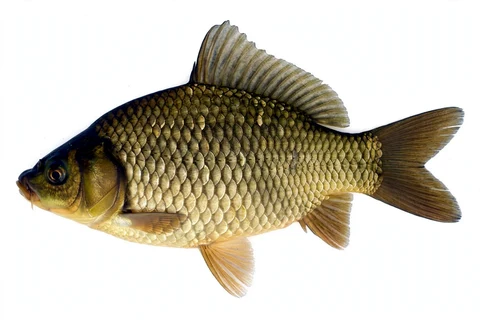
Regulations vary by area and can change in-season — always check the official rules for your area before you fish. Regulations guide →
Plan a trip for Crucian Carp
Build today's plan