
Freshwater · Summer and autumn; the classic autumn 'grayling season' on chalk streams
European Grayling
Thymallus thymallus
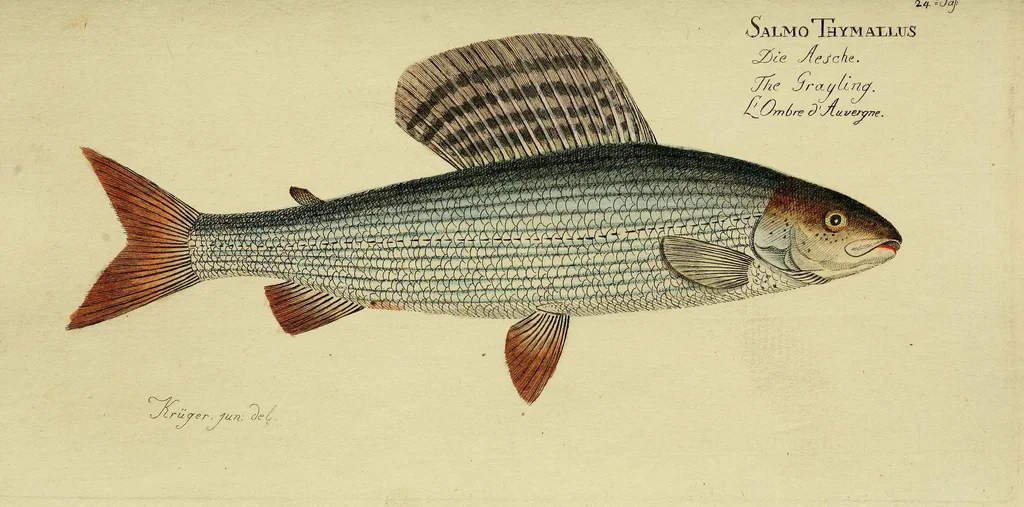
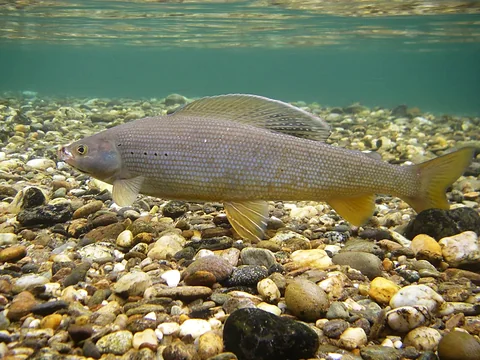
Europe's own grayling — a DIFFERENT species from the guide's arctic grayling (Thymallus arcticus), listed in Habitats Directive Annex V. Its huge sail-like dorsal fin and love of clean gravel rivers make it the classic autumn target on chalk streams. It shares rivers across northern and central Europe with trout.
Seasons · Peak
Identifying features
- Huge, sail-like dorsal fin, iridescent with rows of dark spots and an orange edge in males
- Silvery-grey to golden body with scattered dark spots and a slightly forked tail
- Small, delicate mouth with fine teeth — clearly not a trout's mouth
- Purple and blue iridescent sheen along the flanks in good light
- Slender, elegant body with large scales
Habits
- Shoals in fast, clean water over gravel, rising freely to hatching insects
- Feeds on insect larvae, small crustaceans and surface flies
- Famous for the classic autumn and winter 'grayling season' when trout are out of season
- Spawns in spring over shallow gravel, unlike autumn-spawning trout
- A good indicator of clean water — it disappears from polluted rivers
Distribution
Where to find them
- English chalk streams — Test, Itchen and Wye in autumn
- Scandinavian and central European gravel rivers
- Slovenian and Austrian grayling beats on the Soča and Sava
Where they live
How to catch them
Dry-fly fishing to rising grayling River
Rig: Light fly rod with a small dry fly presented upstream to rising fish over gravel riffles in summer and autumn hatches
Bait/lure: Dry flies matching the hatch
Key tip: Grayling rise repeatedly — stay on one rising fish, go smaller with the fly, and keep the presentation delicate.
Nymphing the runs River
Rig: Nymph setup with beaded nymphs or spiders drifted close to the bottom through riffles and runs in duo or indicator style
Bait/lure: Beaded nymphs and spiders
Key tip: Keep nymphs deep and close to the gravel; takes are subtle — strike at the slightest hesitation of the indicator.
Best baits & lures
Baseline setup
- Rod: Fly rod 8-10 ft, 3-5 wt for rivers
- Line: 3-5 lb tippet on fly tackle
- Terminal: Small dry flies, nymphs, spiders and fine hooks
Recommended gear for this species
Rod · Best value
9' 5-weight fly rod outfit
≈ US$180-260
Covers chironomid lakes and small rivers with one setup.
Flies · Budget
Chironomid assortment (30 patterns)
≈ US$25-40
Chironomids are 60% of a lake rainbow's diet in spring.
Picks come from our rule library — never paid placements. Prices are guides; affiliate links may earn us a commission.
Typical size
Common 1-2 lb (0.45-0.9 kg); large fish to 3 lb (1.4 kg) and about 18 in (45 cm)
On the table
Good — delicate white flesh; often released on catch-and-release grayling waters and taken only within local size and season rules.
Similar species
Regulations vary by area and can change in-season — always check the official rules for your area before you fish. Regulations guide →
Plan a trip for European Grayling
Build today's plan