
Saltwater · Summer and autumn
Monkfish
Lophius piscatorius
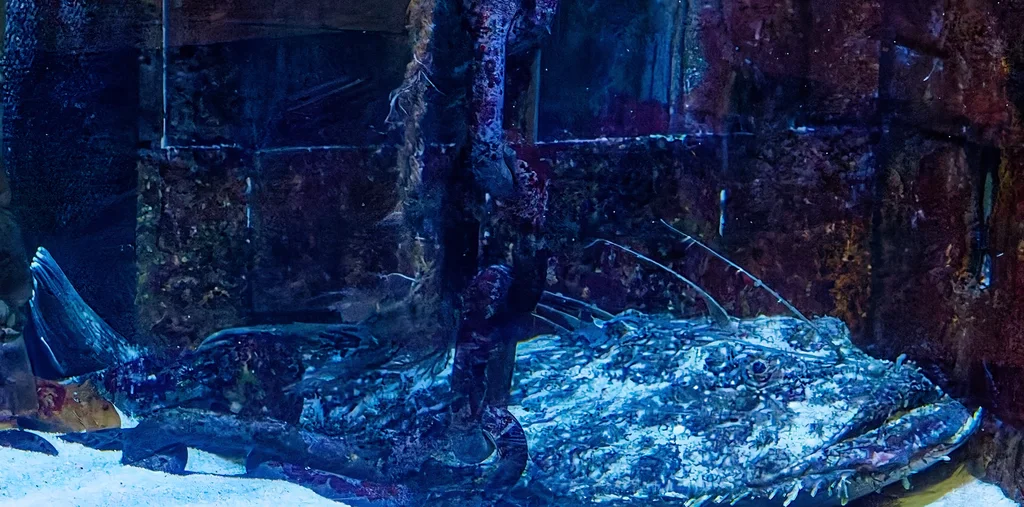
The great flattened ambush predator of European shelf bottoms, burying in sand and luring fish with the fleshy flap on its fishing-rod illicium right in front of its enormous mouth. Only the muscular tail is eaten. Its inward-angled sharp teeth mean careful handling after landing — never reach near the mouth.
Seasons · Peak
Identifying features
- Enormous flattened head and wide crescent mouth — the head is most of the fish
- Modified first dorsal ray (illicium) with a fleshy lure flap in front of the mouth
- Mottled brown-olive skin, loose and scaleless, perfectly matching the seabed
- Rows of long, sharp, inward-pointing depressible teeth
- Tapered tail section behind the head — the part sold as monkfish tail
Habits
- Buries itself in sand and mud with only the lure and eyes showing
- Lures prey with its illicium — a modified fin ray with a fleshy flap waved like a small fish
- Strikes by opening its enormous mouth and sucking prey in whole
- Handle carefully: the mouth is full of long, sharp, inward-angled teeth that can give a serious bite
- Slow-growing and solitary; a true ambush predator that rarely chases
Distribution
Where to find them
- Deep fjord bottoms of Norway
- Shelf edges off Scotland and Ireland
- Deep sand beside Channel reefs
Where they live
How to catch them
Bottom bait over buried monkfish Boat
Rig: Heavy running trace with a single 8/0-10/0 hook and a big fish chunk, anchored over sand next to reefs
Bait/lure: Large mackerel or pout chunk on a single strong hook
Key tip: Give the fish time to take the bait fully — monkfish suck prey in; striking early pulls the hook out.
Slow heavy pirk on the bottom Boat
Rig: Heavy pirk worked slowly just over sand and mud beside reef edges
Bait/lure: Bare or squid-tipped heavy pirk
Key tip: Keep the pirk practically on the bottom; monkfish do not chase upward — they snap at what passes their mouth.
Best baits & lures
Baseline setup
- Rod: Heavy 6-7 ft boat rod
- Line: 40-60 lb braid
- Terminal: Large strong hooks on heavy flowing traces, big leads
Recommended gear for this species
Rod · Best value
9' 5-weight fly rod outfit
≈ US$180-260
Covers chironomid lakes and small rivers with one setup.
Flies · Budget
Chironomid assortment (30 patterns)
≈ US$25-40
Chironomids are 60% of a lake rainbow's diet in spring.
Picks come from our rule library — never paid placements. Prices are guides; affiliate links may earn us a commission.
Typical size
Common 24-40 in (60-100 cm), about 10-25 lb (5-11 kg); large fish to 79 in (200 cm) and 110 lb (50 kg)
On the table
Only the tail is eaten — firm, sweet, prawn-like flesh sold as monkfish tail; the huge head and body are discarded. Never eat the head or cheeks as a substitute without expert preparation.
Similar species
Regulations vary by area and can change in-season — always check the official rules for your area before you fish. Regulations guide →
Plan a trip for Monkfish
Build today's plan