
Freshwater · Spring to early fall best; April to October in upland rivers and creeks
Redeye Bass
Micropterus coosae
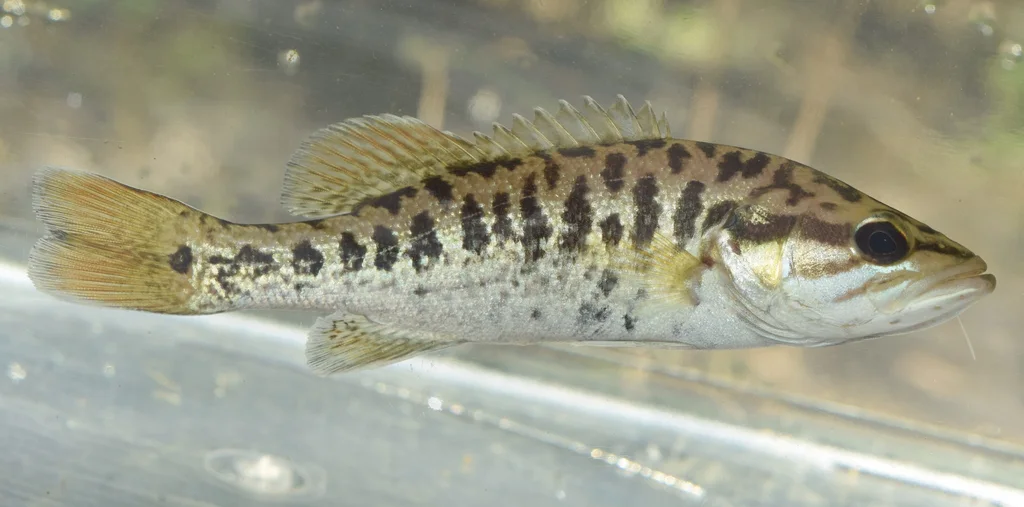
A small, colourful black bass of clear upland streams in the southeastern United States, recognised by its red eye and turquoise-edged fins. 'Redeye bass' is a complex of river-system species told apart mainly by drainage: Cahaba redeye, Warrior redeye, Chattahoochee redeye, Tallapoosa redeye, Altamaha redeye ('Bartram's'), Savannah redeye ('Bartram's'), and the Florida panhandle 'Choctaw' forms (Micropterus calliurus / M. pucpuggy). Micropterus coosae in the strict sense is the Coosa River form.
Seasons · Peak
Identifying features
- Bright red eye, the feature behind the name
- Turquoise to blue-green edges on the fins, tail and gill cover
- Olive-brown body with dark mottling and faint vertical bars
- Rows of dark spots on the pale belly below the lateral line
- Small mouth for a black bass; the jaw does not reach past the eye
Habits
- Holds tight to rocks, shoals and current breaks in clear streams
- Feeds mainly on crayfish, aquatic insects and small fish
- Spawns in late spring to early summer on gravel in quieter margins
- Strong and acrobatic for its size, often jumping when hooked
- Avoids muddy, slow or heavily impounded water
Distribution
Where to find them
- Coosa-system rocky shoals and creek mouths in Alabama and Georgia
- Upland Chattahoochee and Tallapoosa tributary riffles
- Clear foothill streams of the Carolinas and Tennessee
Where they live
How to catch them
Ultralight lures and small jigs in rocky creeks River
Rig: Light 6-6.5 ft spinning rod, 4-8 lb line, 1/16-1/8 oz jig or small spinner worked through shoals and pools
Bait/lure: Small crayfish jigs, beetle spins and micro crankbaits
Key tip: Cast upstream and drift lures past boulders and current seams — redeyes hold tight to rock and strike short.
Fly fishing with poppers and nymphs River
Rig: 4-5 weight fly rod, floating line and 7.5-9 ft leader, small popper or crayfish nymph in clear upland streams
Bait/lure: Small poppers, Woolly Buggers and crayfish nymphs
Key tip: Work poppers slowly over pool tails at dawn and dusk; switch to a nymph along the bottom when fish refuse the surface.
Best baits & lures
Baseline setup
- Rod: Light 6-6.5 ft spinning rod or 4-5 weight fly rod
- Line: 4-8 lb mono or fluorocarbon; floating fly line
- Terminal: 1/16-1/8 oz jigs, small spinners, size 6-10 poppers and nymphs
Recommended gear for this species
Rod · Best value
7'3" medium-heavy casting rod
≈ US$100-150
One rod for jigs, Texas rigs and frogs — the bass workhorse.
Reel · Budget
7.1:1 baitcasting reel
≈ US$80-120
Fast retrieve for pitching and quickly taking up slack on hooksets.
Line · Budget
15 lb fluorocarbon (200 yd)
≈ US$18-25
Invisible in clear water, sensitive on rock, abrasion resistant.
Picks come from our rule library — never paid placements. Prices are guides; affiliate links may earn us a commission.
Typical size
Common 6-10 in (15-25 cm), 0.5-1 lb (0.2-0.5 kg); large fish to about 14 in (36 cm)
On the table
Fair to good — firm white flesh, but most stream fish are small and often released.
Similar species
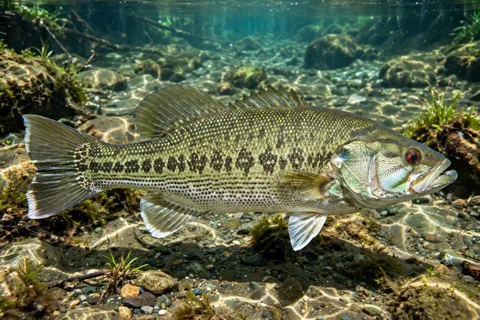 Shoal BassShoal bass grows larger, has bold vertical bars and a spotted-type tooth patch, and lacks the redeye's turquoise fin edges and bright red eye
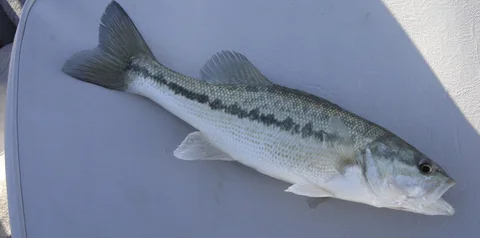 Alabama BassAlabama bass is a reservoir and large-river spotted-type bass with a bold lateral stripe and tooth patch; redeye is a small upland-stream fish with a red eye and turquoise fin edges
Regulations vary by area and can change in-season — always check the official rules for your area before you fish. Regulations guide →
Plan a trip for Redeye Bass
Build today's plan