
Freshwater · Year-round in reservoirs; spring and fall best, March to June and September to November
Alabama Bass
Micropterus henshalli
A spotted-type black bass native to the Mobile Basin of Alabama and Georgia, now spread widely through reservoirs in the Southeast. Outside the Mobile Basin it is invasive: it hybridises with smallmouth, shoal and redeye bass and can swamp their genetics, so several states ask anglers not to release Alabama bass caught outside its native range — check local rules and never move live fish.
Seasons · Peak
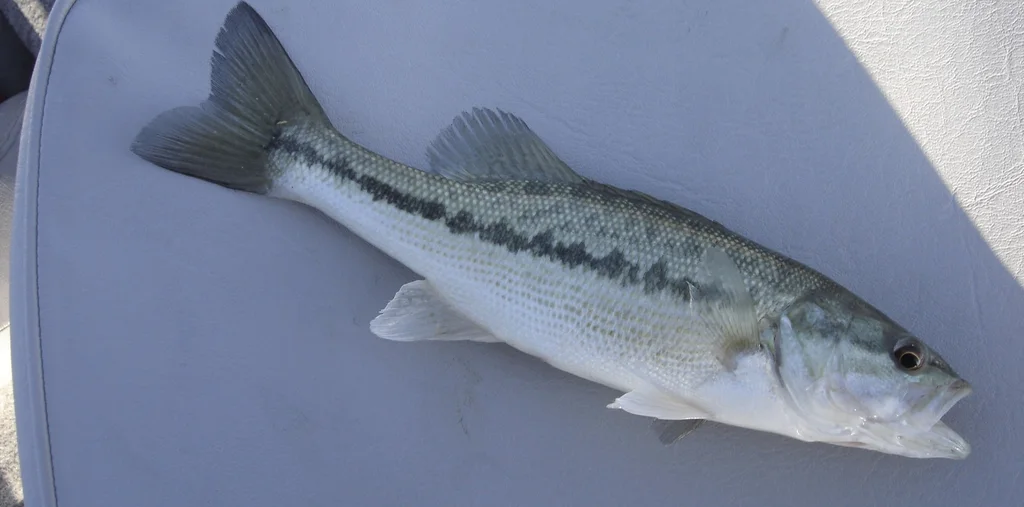
Identifying features
- Bold dark lateral stripe with blotches along the side, like a spotted bass
- Small patch of teeth on the tongue — present in Alabama and spotted bass
- Lateral stripe is broad and clearly blotched; rows of spots below it
- Jaw does not extend past the eye; body slimmer than a largemouth
- Usually 9-15 in; told from spotted bass mainly by range, scale and stripe details — the two are very close
Habits
- Schools offshore over points, humps and brush in reservoirs
- Feeds on shad, crayfish and insects, often in open water
- Spawns in spring on gravel in coves and creek arms
- Aggressive and numerous where introduced, outcompeting native basses
- Hybridises readily with smallmouth, shoal and redeye bass outside its native basin
Distribution
Where to find them
- Mobile Basin reservoirs and rivers in Alabama
- Coosa and Tallapoosa chain lakes in Alabama and Georgia
- Introduced reservoirs in the Carolinas, Tennessee and Georgia
Where they live
How to catch them
Finesse soft plastics and jigs on reservoir structure Lake
Rig: Medium-light spinning rod, 6-10 lb fluorocarbon, shaky head or drop shot with a small worm on points, humps and brush
Bait/lure: Small finesse worms, Ned rigs and jig trailers
Key tip: Use electronics to find schools on offshore structure and keep the bait on the bottom — spotted-type bass feed down.
Small swimbaits and shaky heads in rivers and creeks River
Rig: Medium spinning or baitcasting rod, 8-12 lb line, 3-4 in swimbait or shaky head worked through creek channels and current seams
Bait/lure: Small paddletail swimbaits and finesse worms
Key tip: Target current breaks and creek mouths in spring; river fish hold tighter to cover than reservoir schools.
Best baits & lures
Baseline setup
- Rod: Medium-light to medium 6.5-7 ft spinning rod
- Line: 6-12 lb fluorocarbon
- Terminal: Shaky heads, drop-shot weights, small swimbait heads and finesse worms
Recommended gear for this species
Rod · Best value
7'3" medium-heavy casting rod
≈ US$100-150
One rod for jigs, Texas rigs and frogs — the bass workhorse.
Reel · Budget
7.1:1 baitcasting reel
≈ US$80-120
Fast retrieve for pitching and quickly taking up slack on hooksets.
Line · Budget
15 lb fluorocarbon (200 yd)
≈ US$18-25
Invisible in clear water, sensitive on rock, abrasion resistant.
Picks come from our rule library — never paid placements. Prices are guides; affiliate links may earn us a commission.
Typical size
Common 9-15 in (23-38 cm), 0.5-2 lb (0.2-0.9 kg); large fish to about 18 in (46 cm) and 4 lb (1.8 kg)
On the table
Good — firm white flesh like spotted bass; where it is invasive, keeping fish is often encouraged.
Similar species
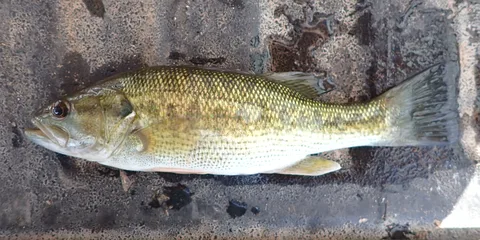 Spotted BassSpotted bass is the close Ohio–Mississippi relative with a tongue tooth patch too; Alabama bass is the Mobile Basin form with a broader, more heavily blotched lateral stripe — range and drainage are the practical separators
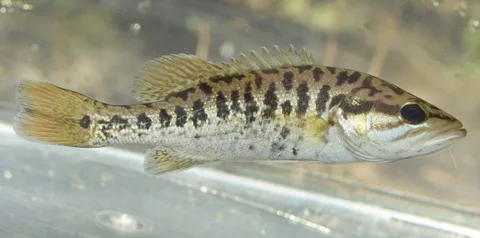 Redeye BassRedeye bass is a small upland-stream fish with a red eye and turquoise fin edges; Alabama bass is a larger reservoir spotted-type fish with a bold lateral stripe
Regulations vary by area and can change in-season — always check the official rules for your area before you fish. Regulations guide →
Plan a trip for Alabama Bass
Build today's plan