
Saltwater · Late spring through autumn
Two-banded Seabream
Diplodus vulgaris
The smartest of the Mediterranean Diplodus breams, recognised by exactly two black bands — one behind the head and one at the base of the tail. Its close relative the sharpsnout seabream (Diplodus puntazzo), with a more pointed snout and thinner bands, is handled here on this page rather than given a page of its own. A cautious rock fish that rewards a quiet bait at dusk.
Seasons · Peak
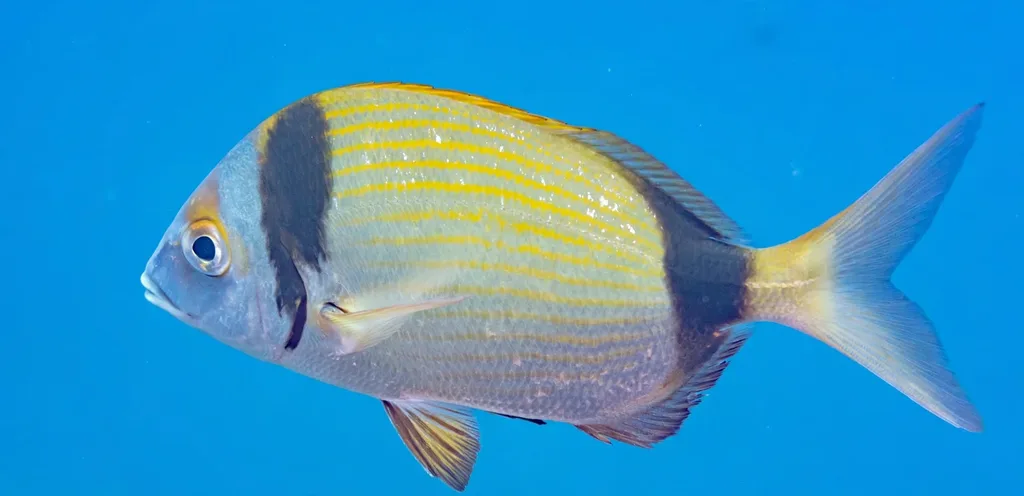
Identifying features
- Silvery body much deeper than it is long, with a steep head profile
- Exactly two bold black bands: one across the nape behind the head, one at the base of the tail
- Black edge to the tail fin and a black spot at the upper pectoral-fin base in most fish
- Faint grey vertical bars between the two main bands in younger fish
- Pointed snout with narrow incisor teeth, less blunt than white seabream
Habits
- Roams reef and broken ground in small groups or singly
- Crushes sea urchins, mussels, crabs and worms with strong jaws
- Feeds best at dawn and dusk and over a chummed rock mark
- Wary like all Diplodus — noise and shadows put it down
- Spawns in autumn and winter; juveniles live very shallow
Distribution
Where to find them
- French Mediterranean rocky reefs and breakwaters
- Italian Adriatic rock groynes and reef edges
- Spanish Mediterranean rock-to-sand edges, occasional on the Atlantic side
Where they live
How to catch them
Sliding float over rocky ground Rock fishing
Rig: Sliding-float rig on a long rod, size 4-6 hooks, bait held a foot above the rock bottom on reef edges
Bait/lure: Prawn pieces, mussel or marine worm
Key tip: Keep the bait just off the bottom — this bream patrols flush over rock and shuns a bait buried in weed.
Light ledgering on reef edges Boat
Rig: Light running ledger of 1-2 oz with a size 4 hook on a 3 ft trace, fished on the sand edge of reefs
Bait/lure: Mussel flesh and shrimp pieces
Key tip: Anchor up-tide of the edge and cast to the transition; chum sparingly with bread and crushed shell.
Best baits & lures
Baseline setup
- Rod: 13-16 ft float rod or light surf rod
- Line: 10-14 lb mono with a 6 lb fluorocarbon leader
- Terminal: Sliding floats, small shot, size 4-6 hooks, light ledgers
Recommended gear for this species
Rod · Best value
9' 5-weight fly rod outfit
≈ US$180-260
Covers chironomid lakes and small rivers with one setup.
Flies · Budget
Chironomid assortment (30 patterns)
≈ US$25-40
Chironomids are 60% of a lake rainbow's diet in spring.
Picks come from our rule library — never paid placements. Prices are guides; affiliate links may earn us a commission.
Typical size
Common 8-12 in (20-30 cm), about 0.7-1.5 lb (0.3-0.7 kg); large fish to 17 in (45 cm) and over 3 lb (1.4 kg)
On the table
Good — sweet, firm flesh, excellent grilled whole or baked; a sought-after table bream.
Similar species
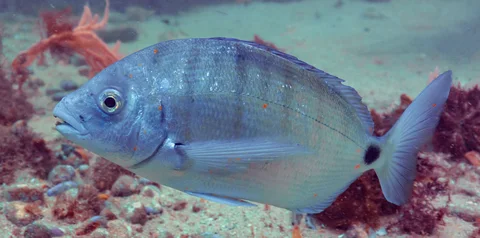 White SeabreamWhite seabream has about five grey bars and protruding teeth; two-banded seabream wears exactly two coal-black bands — nape and tail base — and no others
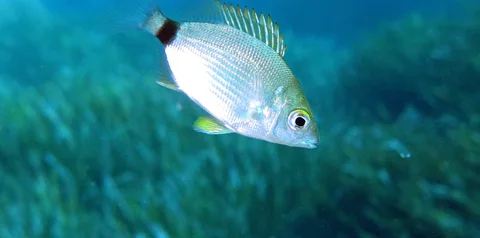 Annular SeabreamAnnular seabream is far smaller and has a tail-base ring only, with no nape band; two-banded seabream has the nape band and grows twice as large
Regulations vary by area and can change in-season — always check the official rules for your area before you fish. Regulations guide →
Plan a trip for Two-banded Seabream
Build today's plan